The Futures App CEO on Buying Sandlot: Player Development, Payments, and the Curve Sports Partnership

The Futures App on Buying Sandlot Podcast
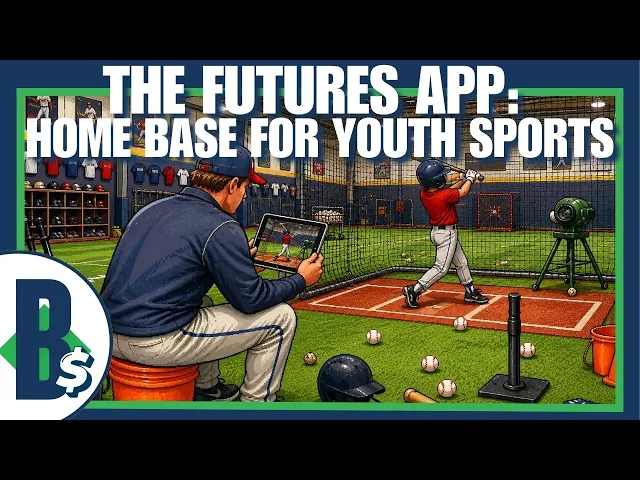
Quick answer: The Futures App is an all-in-one youth sports platform that combines player development (video analysis, drill libraries, metrics tracking) with the full financial stack (registration, bookings, memberships, and bulk invoicing) in a single system. In this Buying Sandlot interview, founder and CEO Jake Hirabayashi explains why the company leads with its training stack, how it's expanding beyond baseball into soccer, volleyball, basketball, and football, and what its partnership with Curve Sports looks like.
The Futures App founder and CEO Jake Hirabayashi sat down with the Buying Sandlot podcast to talk through how the company is building a single operating system for youth and travel sports organizations. The conversation covered the player development modules, multi-sport expansion, Jake's case for going vertical instead of betting on interoperability, the payments and website products, and a new partnership with Curve Sports.
Below is a summary of the key points, a full FAQ, and the complete cleaned transcript.
What is The Futures App?
The Futures App is an all-in-one platform for the youth sports segment. It combines everything a modern sports organization needs in one place: the player development stack (tools and tracking, video, metrics, drills, and drill assignment) and the financial stack (facility management, bookings, lessons, classes, rentals, registrations, and invoices).
As Jake put it, the goal is "to create a one-stop shop for all these folks and give them a single point of operating their business."
Why does The Futures App lead with player development?
Most competitors in this space — TeamSnap, LeagueApps, and similar tools — are built primarily around registration, scheduling, and parent communication, with instructional video treated as a secondary add-on. The Futures App inverts that. Two reasons:
Founder experience. Jake played baseball at UCLA and had a brief stint with the Minnesota Twins, so the player-coach relationship was a natural starting point for the product.
The development gap. For elite travel clubs and training facilities, there's a long stretch of "gray space" between when a player registers and when the season ends. The Futures App captures that window — training programs, drill assignments, and coaches' notes across a three-to-six-month season.
Everything in the development stack is built around the player profile. Coaches, players, and parents can upload video; coaches can slow-mo, draw on, voice over, and compare footage to prior performances, then re-render it back to the player. Operators get prefab drill libraries (or can upload their own), assign strength and conditioning programs, and configure custom metrics that build trend lines showing how an athlete is progressing over 5, 6, even 18 months — far richer than a single data point at a showcase.
What's the real competitive advantage?
Jake framed it with a hypothetical operator: "Tom" runs a baseball training facility in Denver with 15 teams, 225 players (so ~450 parents), and five coaches. To run that business across team and training needs, Tom might juggle three to seven apps — somewhere around 3,000 to 4,000 app downloads across his audience just to keep operations going.
The Futures App's differentiation is tool consolidation — vertically integrating that entire stack into one layer of organization. (For more on the cost of running fragmented tooling, see our piece on the hidden cost of running your sports org on five different apps.)
Which sports does The Futures App support?
The platform started in baseball because of the team's domain expertise, but the underlying toolset — training, payments, communication — is largely sport-agnostic. The main differences are niche (camera angles for baseball vs. soccer video, for example), not structural.
The company is now seeing traction in soccer, volleyball, basketball, and football (both flag and tackle, including the growing girls' flag football segment), with a long-term goal of serving every sport.
What does The Futures App think about interoperability?
Jake is candid that he's skeptical youth sports will become truly interoperable. The market is highly fragmented, there's heavy product overlap among the big players, and little incentive for competitors to integrate directly with one another. In his view, the space stays fragmented because no one has solved the full stack — partly because the venture community historically neglected the earliest stages of these companies, leaving private equity to step in later.
His conclusion: some narrow features (like scheduling) can be interoperable because they don't touch the big players' bottom line, but the durable winner will be a vertical, full-stack solution that eventually pulls operators onto a single platform.
What's included in the payments and website products?
The payments stack spans registrations, memberships with benefits, bookings, and a popular bulk invoicing feature. The emphasis is on streamlining collection and reducing accounts-receivable balances so clubs become financially healthier. Because the products are built natively together, operators can tie benefits and credits to services like lessons, classes, and rentals — creating a connected flow for operators, parents, and players. (More on what clubs actually need in our youth sports registration software guide.)
The website builder is what Jake called a "hidden differentiation." Where many providers spin operators up in a WordPress-style editor, The Futures App lets them control their site from a simple table-driven database — no web editor required.
What is the Curve Sports partnership?
The Futures App began working with Curve Sports last year and is deploying its technology across Curve's entire portfolio. Jake described Curve's leadership as high-integrity operators and said the partnership has helped The Futures App refine its product through close work with experienced clubs. One concrete integration: clubs configure Curve test metrics (bat speed, exit velocity, throwing velocity, and so on), run players through testing using their existing hardware, and store and trend that data inside The Futures App.
How much funding has The Futures App raised?
The Futures App has raised just north of $9 million across a few rounds, from investors including Entrada Ventures and Soul Venture Partners, and expects to raise additional capital in the future.
Frequently Asked Questions
What is The Futures App? The Futures App is an all-in-one youth and travel sports management platform that combines player development tools (video analysis, drill libraries, metrics and trend tracking) with a full financial stack (registration, bookings, memberships, lessons, and bulk invoicing) in a single system.
What sports does The Futures App support? It started in baseball but now supports soccer, volleyball, basketball, and football (both flag and tackle), with a long-term goal of serving every sport. The core toolset works across sports with only minor sport-specific differences like video camera angles.
How is The Futures App different from TeamSnap or LeagueApps? Those platforms are built primarily around registration, scheduling, and communication, with training as a secondary add-on. The Futures App leads with player development — video analysis, drill assignment, strength and conditioning, and athlete metric trend lines — and consolidates the team, training, payments, and website tools that operators would otherwise run across three to seven separate apps.
Does The Futures App handle payments? Yes. Its payments stack covers registrations, memberships with benefits, bookings, lessons, classes, rentals, and bulk invoicing, with a focus on reducing accounts-receivable balances. Because the products are built natively together, operators can tie credits and benefits directly to their services.
Who founded The Futures App? Jake Hirabayashi is the founder and CEO. He played baseball at UCLA and had a brief stint with the Minnesota Twins, which shaped the platform's focus on player and coach development.
How much has The Futures App raised? The company has raised just north of $9 million from investors including Toronto Ventures and Soul Venture Partners.
What is the Curve Sports partnership? The Futures App is deploying its technology across Curve Sports' portfolio of clubs, including using its platform to store and trend the data from Curve's testing programs.
Watch the full interview
Originally published on Buying Sandlot.
Full Transcript
Lightly edited for readability.
Chapter 1: Training Modules & Player Development
Buying Sandlot: Welcome back to Buying Sandlot. Today we're talking to Jake Hirabayashi, founder and CEO of The Futures App — an all-in-one youth sports technology platform focused on team management, training delivery, and athlete development. In this interview, we dive deeper into the player development modules, expanding into new sports, his thoughts on interoperability, and a new partnership with Curve Sports. We're here with The Futures App founder, Jake Hirabayashi. Thanks for coming on Buying Sandlot — we really appreciate it. Very interesting app, very interesting business model that I've been researching for the last 48 hours. Before we get into it, just give the listeners a baseline view of what The Futures App is.
Jake Hirabayashi: Absolutely, super excited to be here — big fans of you guys as well. I've consumed your content on YouTube, big e-learner, so thanks for having me. We're an all-in-one platform in the youth sports segment. What we do is combine everything a modern sports organization would need — from the player development stack (tools and tracking, video, metrics, drills, drill assignment) to the financial stack (facility management, bookings, lessons, classes, rentals, registrations, invoices, the whole deal). We're trying to create a one-stop shop for all these folks and give them a single point of operating their business.
Buying Sandlot: You have the team management and the payment systems down — we've seen that with a lot of other service providers — but you also do player development and video analysis. When you're talking to customers, what's the main competitive advantage? Is there a certain feature primarily driving signups right now?
Jake Hirabayashi: I'm going to humanize this a little bit. Think about a hypothetical customer — let's call him Tom. He owns a baseball training facility in Denver, has 15 teams, 225 players, so assume 450 parents, and five coaches. To make his business go around — anything on the training side, anything on the team side — he might have three to seven apps. So he's managing somewhere in the realm of three to four thousand app downloads just to make his business run. Where we find differentiation is tool consolidation — vertically integrating a stack and creating a new layer of organization for these clubs. If you're looking at a differentiating factor, the most visible thing is the training stack. We fit really well with folks that offer training as part of their registration — maybe it's a five-month season with in-depth training programs that actually help the players develop. That's where we start to find a high goal.
Buying Sandlot: When you go on the website, it's heavy on coaching and instruction; same on social media. That's not really a core focus of your TeamSnaps or LeagueApps — their core focus is registration, scheduling, comms between parents, with instructional videos layered on top as secondary add-ons people may never use. Why such a heavy focus on training and drills?
Jake Hirabayashi: Two elements. One, we probably have some bias from living through that experience from the player perspective — I played baseball at UCLA and had a short stint with the Minnesota Twins, so I was keen on the player-coach interactions as you climb the ladder of sports. Two, a lot of those other companies were founded by youth sports parents who were upset with the stack that existed. Our product was developed from the point of view of our actual experience. And if you get into elite travel clubs or training facilities that really focus on developing your son or daughter and giving them an opportunity to play at the next level, there's a lot of gray space between when you sign up for registration and when the season's over. Our platform captures quite a bit of it — the training programs, the drill assignments, the coaches' notes across a three-, four-, five-, six-month season.
Buying Sandlot: Walk me through the training modules — how players sign up, what they go through, and the experience on both the trainer and player sides.
Jake Hirabayashi: We offer a litany of tools, all centric around the concept of the player profile. Every player in our platform has their own player profile. Coaches, players, and parents with access to that kid can upload video on their behalf, and the players can upload video themselves. Once video is uploaded, coaches can slow-mo, draw, compare to any prior performance or standardized videos, voice over, and re-render a video back to the player. We have whole drill libraries we prefab with content, and every operator can upload their own — if they have hyper-niche training programs they want to assign, they can assign drills, and also strength and conditioning programs. We also enable orgs to track data on players — they can configure whatever metrics they'd like and build trend lines. The trend lines are really cool, and they're an interesting differentiation point: when the operator interacts with these kids every single day, you get a really rich dataset on how they're performing in a specific metric over five, six, seven, even 18 months — rather than just a data point at a showcase. You get a very detailed progression line, and it can tell a lot about how a kid is actually progressing.
Chapter 2: Expansion Into Different Sports
Buying Sandlot: Baseball seems to be your primary sport, because you played it. Talk about the other sports you're offering training for — and are you looking to get into other sports down the line?
Jake Hirabayashi: When you think about the toolset — training, payments, communication, anything we build — the needs of the sports operator don't really change. They all do the same things. There are niche nuances, like the video angles of baseball versus soccer being a little different, but the toolset is pretty much the same. Our long-term goal is to serve every single sport. We started in baseball because of our rich domain expertise, but we're starting to have a lot of success in soccer, volleyball, basketball, and football. Focus is obviously really important as a startup.
Buying Sandlot: Is that tackle, flag, or both?
Jake Hirabayashi: A little bit of both, honestly. You're starting to see more flag football for girls coming up, which is pretty cool — my stepsisters are actually playing it here in California.
Chapter 3: Interoperability & Payment Solutions
Buying Sandlot: You market yourself as the all-in-one platform. We talk about interoperability a lot on this platform. What are your thoughts on it?
Jake Hirabayashi: Interoperability is an interesting topic. If we go a couple layers deeper, I'm somewhat skeptical of us getting to a state where youth sports as a market is truly interoperable, just because of how fragmented it is and how much product overlap there is between the big players — so there isn't a huge incentive to directly integrate. Youth sports is fragmented because no one has solved the full stack. I think the full stack eventually wins. Part of why no one has solved it is that the venture community has neglected the very beginning parts of these companies' journeys — it's been hard for a lot of the big players to raise money early. At a certain point private equity gets involved and they access big capital. There are certain components that can be truly interoperable — you're seeing some of it with scheduling, something that doesn't necessarily touch the bottom line of big players. But interoperability might be a stretch given how the platforms and business models are structured. There's a good incentive for parents to want it, but I'm a little skeptical. Building a vertical solution is probably where we'll stay focused, and we hope to eventually pull everyone into a single platform.
Buying Sandlot: We touched on training and team management, but you also have features like website production and a payments product. Can you talk about both?
Jake Hirabayashi: Our payments product has a lot of breadth — registrations, memberships with benefits, bookings, the whole deal. We also have the bulk invoicing feature, which is really popular. We're proud of our payment stack and we're going to keep investing in it, because money is the lifeblood of every business. If we can make collection more streamlined and reduce AR balances for these clubs, we're creating a much healthier customer. One big selling point: if you have a facility offering — lessons, classes, rentals — and you want to tie benefits to it, because we built everything natively, the way our products interact lets you tie benefits and credits to your services, which creates a fun flow for the operator, the parent, and the player. On websites — this is kind of a hidden differentiation. A lot of the big providers basically spin you up in a WordPress-style account, and if you want to make edits you're asking a club operator to get into a web editor. There's a spectrum of operators — some are phenomenal in web editors and a lot are not. Our product lets you control your database from a very simple table. You're not getting into a web editor. If you hate web editors, give us a call — it's going to change your life. You should ask the Power guys; I know you interviewed Brian and Eric about it, and they went to the nth degree with it.
Buying Sandlot: So if I go on their website, I should see one built by The Futures App?
Jake Hirabayashi: Oh yeah.
Chapter 4: Partnership With Curve Sports
Buying Sandlot: That leads into my last question — what are you doing with Curve Sports? I know you have a new partnership that just came across the fold.
Jake Hirabayashi: We started working with Curve Sports last year, and it's been awesome — the family is tremendous, and Michael is phenomenal. Basically we're deploying our technology across their entire portfolio. It's been an awesome experience — I've gotten to learn a lot about how these folks really operate and what really matters, and we've refined our product a lot by working with them. To anybody out there looking at Curve — maybe you're a club operator reaching a point of scale — not all dollars are treated the same. These are awesome, super high-integrity folks; I highly recommend interacting with them. You can fill out a form on their site to talk to them, on the site we built. They're some of the best operators in the space — from the Show to the Ostinger's to the folks over at Power. What all these guys have in common is they genuinely care about their customer; they're incredibly altruistic operators. That same theme applies at the Curve Sports corporate level too. We're excited to up-level all these organizations, and also help the players get better, track their progress better, and become the best players they possibly can be.
Buying Sandlot: How does your training model fit in with their test centers? Has there been any conversation on that?
Jake Hirabayashi: The data tracking is one of them. Every org can configure whatever metrics they care about, so they configure Curve test metrics — bat speed, exit velocity, throwing velocities, all this stuff. They run their players through a test, and you can bulk-apply data isolating a single metric for whatever you're testing. They're deploying our product as part of their tests — still using some hardware providers to track the data, then storing it in our platform.
Chapter 5: Funding Journey & Future Raises
Buying Sandlot: I know you've raised a couple rounds. What does the funding look like right now — how much have you raised, and what are you looking for in the future?
Jake Hirabayashi: We've raised a few rounds from super great folks — Toronto Ventures and Soul Venture Partners, fantastic people. We've raised just north of $9 million. We'll probably raise a little bit more in the future. It's been a good journey — we've learned a lot the whole way and we've been fortunate enough to continue to grow.
Buying Sandlot: We appreciate you coming on. Good luck with everything at The Futures App and with the Curve Sports partnership. Excited to follow along and see what you come up with in the future.
See it for yourself
Curious how an all-in-one platform replaces the three-to-seven apps most clubs juggle? See how The Futures App handles player development, payments, and operations →
Related reading:
The Futures App is the all-in-one platform built for youth and travel sports organizations. We help coaches, club directors, facility owners, and independent trainers run their entire operation from a single app — so they can spend less time on administration and more time developing players.
The platform combines everything a modern sports organization needs: player development tools for tracking video, metrics, and drills; facility and booking management with real-time availability; payments and registration for memberships, teams, camps, and bulk invoicing; team communication through structured channels and direct messaging; and professional website hosting built for sports organizations.
The Futures App is used by clubs, academies, and training facilities across baseball, softball, basketball, soccer, volleyball, lacrosse, football, and more. Whether you're running a 200-family travel club or a single-sport training facility, the platform is designed to grow with your organization.
If you're ready to stop duct-taping tools together and run your organization the way it deserves to be run, book a demo and see The Futures App in action.