Why Running on Five Different Tools Is Costing You More Than You Think
Intro
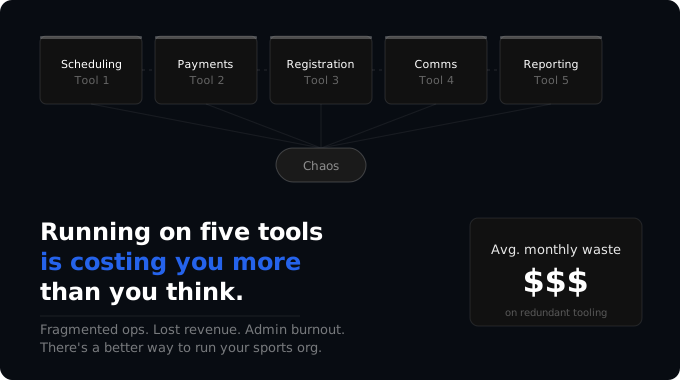
If you run a youth sports business (an academy, a club, a training facility) your tech stack probably looks something like this:
One platform for team registration
A different one for lesson or camp bookings
Stripe or Square bolted on for payments (or worse, Venmo and checks)
A spreadsheet for player notes and progress tracking
A WordPress site that hasn't been updated since your nephew set it up in 2021
Sound familiar? You're not alone. And none of those tools are necessarily bad on their own. The problem is the space between them.
The Hidden Cost of a Fragmented Stack
When operators come to us, the conversation rarely starts with "I have too many tools." It usually starts with something like:
"We lost a registration because a parent couldn't figure out the checkout.""I have no idea what our payment processing fees actually are.""One of my coaches updated the wrong thing on the website and now it's broken."
These are symptoms of the same disease: software that wasn't built to work together.
Here's what fragmentation actually costs a youth sports business:
1. Margin leakage from payment chaos:
When payments run through multiple systems, a registration platform here, a booking tool there, maybe a POS for in-person…you're paying processing fees in multiple places, often without a single view of your total revenue. Most operators we talk to can't tell us their effective payment processing rate off the top of their head.
2. Parent experience friction that kills conversions
Every time a parent has to create a new account, re-enter their credit card, or navigate to a third-party site to complete a registration, you lose some of them. They're busy. They're doing this on their phone. Checkout abandonment in youth sports registration is a real, measurable problem….and disconnected tools make it worse.
3. Staff time nobody's tracking
What does it cost when your front desk coordinator has to manually reconcile a registration list from Platform A with a payment confirmation from Platform B before every session? If that's a 30-minute task that happens 3 times a week, that's 78 hours a year, roughly two full work weeks, spent on a problem that unified software eliminates.
4. Data that doesn't talk to itself
When your registration data lives in one system and your player development notes live in a coach's iPhone, you have no institutional memory. A player's history: their attendance, their progress, their video, their custom training program disappears when a coach leaves or when you switch tools. That's a real retention and recruiting liability.
What "All-in-One" Actually Means
The term gets thrown around, but it's worth being specific. A genuinely unified platform for a youth sports operation should handle:
Registration: Teams, leagues, tournaments, and camps.
Parents should be able to enroll, pay, and receive confirmation in one uninterrupted flow. No redirects. No third-party checkout pages.
Bookings: Private lessons, facility rentals, group classes, and memberships.
These are fundamentally different from registration (recurring or flexible scheduling vs. cohort enrollment), and most platforms only do one or the other well.
Payments: Embedded, not bolted on.
This means a single payout, a single dashboard, a clear view of your gross revenue, net revenue, and processing costs. You should be able to see your effective take rate at any moment.
Player Development: Profiles that persist across seasons. Video storage. Coach notes. Drill and workout assignments.
The operational side of your business and the development side of your business should share the same data.
Your Website: The world's first impression of your business…
Not an iframe embed that breaks your SEO. Not a WordPress installation that requires a developer every time you want to update your pricing page. Your public-facing presence should be connected to your operations, not a separate project.
The "Good Enough" Trap
There's a version of this conversation where an operator says: "Yeah but we've made it work. We know our systems."
We hear this a lot, and we respect it. You've built workarounds. Your staff knows the quirks. It works.
But "works" is a low bar when the alternative is a platform where:
A new registration takes 3 minutes to set up instead of 45
A parent can book a lesson and pay in the same flow they used to register their kid for the spring season
You can see total revenue, by product line, in one dashboard
A coach can pull up a player's training history and last three video clips before a session
The operators who win in youth sports over the next five years aren't going to be the ones who were best at managing complexity. They're going to be the ones who eliminated it.
What to Actually Look For
If you're in the market (or starting to think about it) here's a short framework:
Does it handle both registration and bookings natively?
Not via an integration. Not via a third-party plugin. Built in. This is the single biggest gap in the market right now. Most platforms do one well and ignore the other.
Are payments embedded or added on?
If you're being redirected to Stripe's hosted checkout or a third-party processor, payments are not embedded.
Can your coaches and staff actually use it?
Sophisticated reporting that nobody uses is worthless. The best platforms are built for the operator who is also a great coach first, not a software power user.
Does it make your website better or worse?
If the answer is "you'll need to embed our widget," your SEO will suffer and your parent experience will suffer. The platform should improve your web presence, not fragment it.
The Bottom Line
Youth sports is a real business. The margins aren't enormous, the seasonality is punishing, and parents have high expectations. The last thing you should be spending your energy on is duct-taping software together.
The businesses that run on unified platforms spend less on processing, convert more registrations, retain more families, and give their coaches better tools to develop athletes. That's not an accident. It's what happens when your operations are built on infrastructure that was designed for this specific business not assembled from generic tools.
A brighter Future!
If you're evaluating where to start, begin with payments and registration. Get those unified first. The efficiency compounds from there.
The Futures App is built specifically for youth sports businesses, combining registration, bookings, embedded payments, player development, and websites in one platform.